How to Build Your First AI Agent Workflow
A practical guide to breaking down a high-level goal into a deterministic, step-by-step execution plan your agents can run reliably.

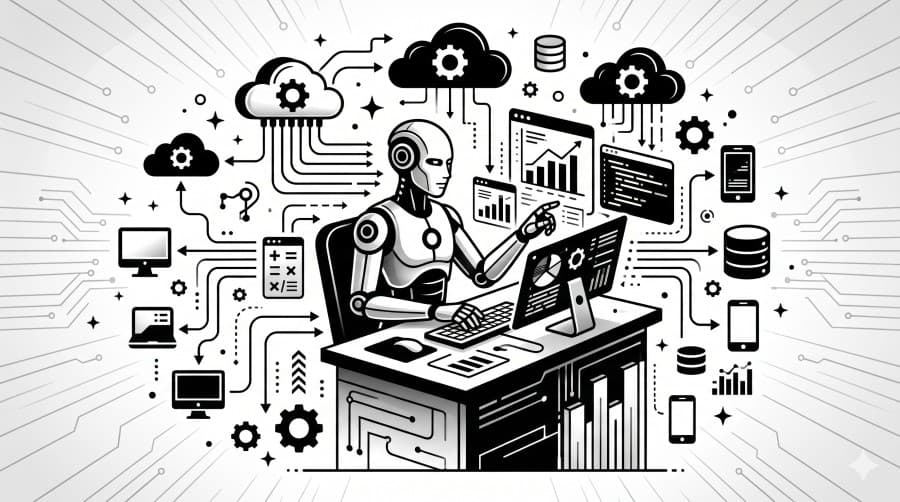
Building an AI agent that reliably executes a multi-step task is harder than it looks. The naive approach — give the model a goal and hope it figures out the steps — breaks down quickly the moment you need consistency, auditability, or human oversight.
The better approach is a planner-executor split: one model call generates a deterministic plan, and a separate executor runs each step in isolation. This article walks through how that works in practice.
The Planner-Executor Pattern
The core insight is that planning and execution have different requirements:
- Planning needs creativity and context — you want a capable model reasoning about the best sequence of steps.
- Execution needs reliability and focus — each step should call exactly one tool, use the plan as its spec, and not improvise.
Mixing the two into a single ReAct-style loop sounds appealing but creates a fragile system. Any single step failure or hallucination can derail everything that follows.
Designing the Plan
A well-formed plan has three properties:
- Ordered steps — each step has an index, a human-readable description, and a single tool name.
- Static inputs — no runtime variables. The planner derives concrete values (search query, platform, topic) from the user's goal.
- Approval gates — steps that produce publishable content are flagged
requiresApproval: trueso a human can review before execution continues.
Here's an example plan for the goal "Research AI trends and write a LinkedIn carousel":
{
  "title": "LinkedIn AI Trends Carousel",
  "steps": [
    { "stepIndex": 0, "toolName": "web_search", "description": "Search for top 5 AI marketing trends in 2026", "requiresApproval": false },
    { "stepIndex": 1, "toolName": "generate_outline", "description": "Structure a 6-slide carousel outline from search results", "requiresApproval": false },
    { "stepIndex": 2, "toolName": "format_post", "description": "Write the final carousel copy for LinkedIn", "requiresApproval": true },
    { "stepIndex": 3, "toolName": "generate_image", "description": "Generate a hero image matching the carousel theme", "requiresApproval": true }
  ]
}Running Steps in Isolation
Each step runs as a fresh ToolLoopAgent constrained to exactly one tool call (stopWhen: stepCountIs(1)). The agent sees the full conversation history so it can infer inputs from prior outputs — no explicit data passing required.
This isolation has two key benefits:
- Fault containment — a failed step marks the run as failed without corrupting the conversation state.
- Resume capability — after a human approves a paused step, the executor can safely re-enqueue the next step with full context.
Durable Execution with a Queue
Long-running workflows can't live inside a serverless function. A typical workflow of 5 steps — web search, extraction, outline, post, image — can easily run for 3–5 minutes. Most serverless platforms cut you off at 60 seconds.
The solution is a durable queue (we use QStash). Each step completion enqueues the next step as a separate job. The queue handles retries, and each job has its own execution budget.
The workflow doesn't "run" continuously — it advances one step at a time, each step an independent HTTP call.
What to Do Next
Once you have the planner-executor pattern working, the natural next questions are:
- How do you pass context between steps reliably? (Hint: the conversation history is your state.)
- How do you handle approval gates without blocking the queue?
- How do you surface run status to users in real time?
These are exactly the problems the workflow system in this kit is designed to solve out of the box.
More Articles
Human-in-the-Loop: Why Your AI Agents Need a Pause Button
Fully autonomous AI sounds appealing until something goes wrong. Here's how approval gates protect your brand, your users, and your data.
March 22, 2026
Scaling Content Operations with Background Workflows
How small content teams can produce at enterprise volume by delegating research, drafting, and formatting to scheduled AI workflows.
January 18, 2026